
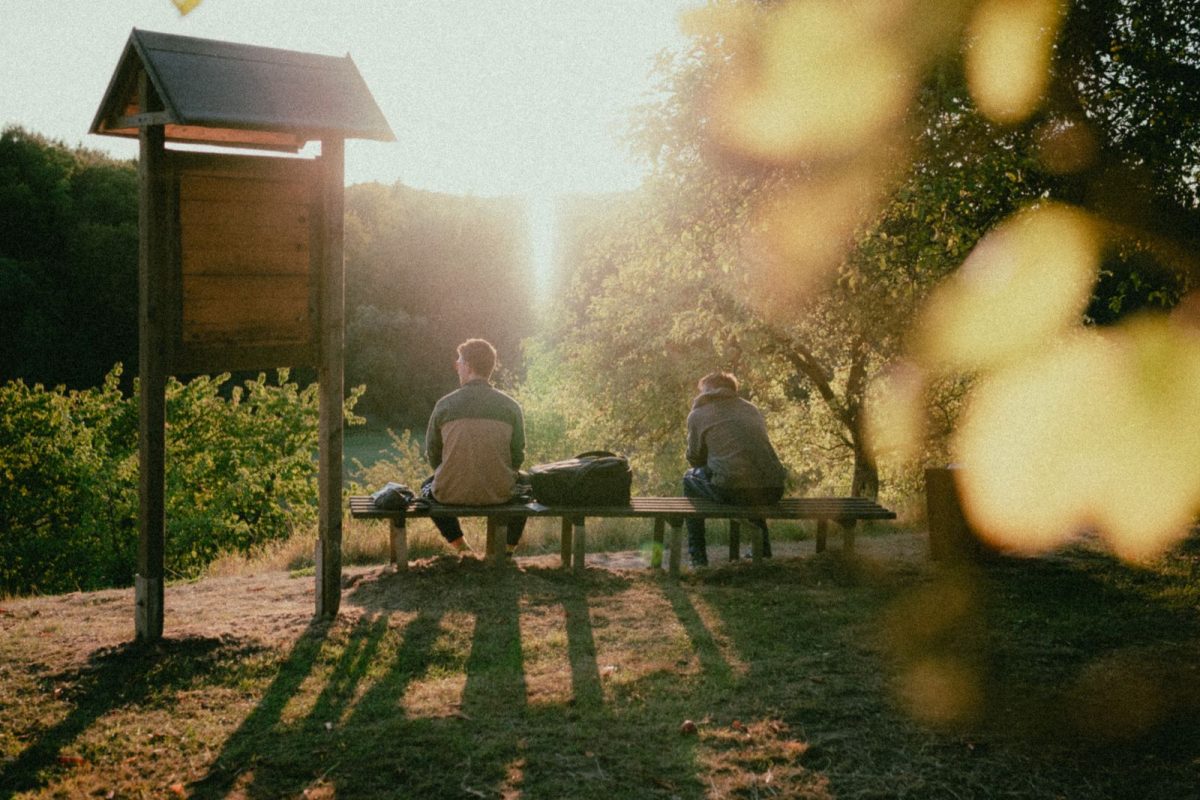
Before groups and social networks existed, the neighborhood already had its forum: a bench, in the shade, at the hour when it cools down.
Every community has a place where it learns about itself. In Levittown, that place is often a bench. There you find out who arrived, who moved away, who needs a hand, and who is organizing something. No agenda or microphone is needed: you just have to sit down.
The bench conversation seems small, but it sustains big things. It sustains the elderly neighbor who lives alone and for whom that while is the best of the day. It sustains the kid who, without realizing it, listens to how problems are solved by talking. It sustains trust, which is the scarcest and most valuable resource in any neighborhood.
Over the years, the ways we communicate multiplied: the telephone, the chat, the Facebook group. All of that helps, and this very magazine is born from those tools. But no screen replaces the “good afternoon” said face to face, or the coffee that appears just because, or the news that arrives walking.
On the bench, a democracy without ballots is also practiced: there everyone has an opinion, from the oldest to the youngest, and the neighborhood’s decisions — the activity being organized, the problem being addressed — are often first cooked in that conversation before reaching any formal meeting. Whoever wants to know what Levittown really thinks should sit a while and listen.
And a memory is practiced. The bench keeps the stories that are in no archive: how the street used to be, who built that house, what business occupied that corner. When an elder of the neighborhood tells, the bench becomes a library; and a neighborhood that remembers is a neighborhood that knows who it is.
Perhaps that is why neighborhoods that know each other care for themselves better. Where people talk, people recognize each other; and where people recognize each other, neglect has a harder time winning. The bench does not solve the big problems, but it creates the environment in which big problems find willing hands.
The bench, moreover, does not understand hurry. In a world where everything arrives by notification and is answered with two letters, sitting down to talk without watching the clock is almost an act of resistance. And how good that it is: neighborhoods are made at the speed of their conversations.
May we never lack a bench with shade. And may we, each time we pass one, remember that a neighborhood is not just a set of streets and houses: it is, above all, the sum of its conversations.



Comentar en Atelier 00949 requiere tu cuenta de Hey Levittown.
Entrar con Hey Levittown